Introduction to Data Mining
Every day, organizations collect enormous volumes of data — transactions, website clicks, sensor readings, patient records, social media activity — but raw data on its own doesn't tell a story. Data mining is the set of techniques used to dig through that raw data and surface the patterns, relationships, and trends hidden inside it, so that businesses, researchers, and institutions can make decisions based on evidence rather than guesswork.
In this lesson, you'll learn:
- What data mining actually means, and how it's different from machine learning
- The step-by-step process behind a real data mining project
- The types of data and data sources data mining works with
- Core data mining techniques, including clustering
- Popular data mining tools
- Real-world applications, advantages, and challenges
What Is Data Mining?
Data mining is the process of analyzing large datasets to discover patterns, trends, and relationships that help organizations make data-driven decisions. In simple terms, it is the process of extracting useful knowledge from large amounts of data.
Data mining is also known as **Knowledge Discovery in Databases (KDD)**. That name is a useful reminder that data mining is not just one algorithm — it's an end-to-end process that starts with raw, messy data and ends with actionable knowledge. Along the way, it draws on statistics, database systems, and machine learning algorithms to find patterns that would be impossible to spot by manually scanning spreadsheets or database tables.
Organizations use data mining to:
- Analyze customer behavior
- Predict future trends
- Improve business strategies
- Discover hidden patterns that aren't visible through simple reporting
- Reduce costs and increase revenue
Data mining is not limited to structured numbers in a database. Depending on the source, it can also take more specialized forms, including:
- Text Mining — extracting patterns and meaning from unstructured text, such as customer reviews or support tickets
- Web Mining — analyzing browsing behavior, clickstreams, and website structure
- Audio and Video Mining — extracting information from recorded speech or video footage
- Image Mining — identifying patterns and objects within image data
- Social Media Mining — analyzing posts, engagement, and network connections on social platforms to understand public sentiment and behavior
Because the underlying data differs so much between these forms, each one typically relies on specialized software and preprocessing techniques suited to that data type.
However, data mining also raises privacy and ethical concerns, because it often involves analyzing personal data — purchase histories, browsing habits, medical records, and similar information. Organizations that mine data are expected to do so ethically and securely, with clear policies on what data is collected, how long it's kept, and who can access it.
Data Mining vs. Machine Learning
These two terms are often used interchangeably, but they answer different questions.
| Aspect | Data Mining | Machine Learning |
|---|---|---|
| Primary goal | Discover previously unknown patterns in existing data | Build a model that generalizes well to new, unseen data |
| Typical question | What patterns or relationships exist in this dataset? | What is the most likely outcome for this new input? |
| Process | An end-to-end pipeline: cleaning, selecting, transforming, mining, evaluating, and presenting data | Typically one stage — training and validating a predictive model |
| Human role | Often analyst-driven and exploratory | Often automated once the model is trained and deployed |
In practice, the two fields overlap heavily. Data mining frequently *uses* machine learning algorithms — such as clustering or classification — as one of its tools for finding patterns. The distinction is really about intent: data mining is about discovering what's already true in a dataset, while machine learning is about using data to predict what will be true for cases the model hasn't seen yet.
The Knowledge Discovery in Databases (KDD) Process
The KDD process describes, at a conceptual level, every stage a dataset passes through on its way to becoming useful knowledge:

2. Data Integration — combining data from multiple sources, such as different databases or file formats, into one consistent dataset.
3. Data Selection — retrieving only the records and attributes that are actually relevant to the current analysis.
4. Data Transformation — converting data into a form suitable for mining, such as normalizing numeric ranges or encoding categorical values.
5. Data Mining — applying algorithms (classification, clustering, association rule mining, and others) to extract candidate patterns from the prepared data.
6. Pattern Evaluation — filtering the discovered patterns to keep the ones that are genuinely interesting, novel, and useful — not just statistical coincidences.
7. Knowledge Presentation — visualizing and communicating the results in a form decision-makers can act on, such as dashboards, charts, or reports.
Notice that "Data Mining" is technically just one step inside the broader KDD process — but in everyday use, the term "data mining" is applied to the whole pipeline. That's the convention this lesson follows too.
A Practical Data Mining Workflow
While KDD describes the concept, most real projects follow a more concrete, project-level workflow. This closely resembles CRISP-DM (Cross-Industry Standard Process for Data Mining), the methodology most widely used in industry analytics projects.
1. Study the Problem
Before touching any data, understand the objective of the project or business problem. This includes:
- Identifying the existing problem
- Understanding project limitations and constraints
- Defining clear, measurable goals
2. Collect Data
Gather the required data from relevant sources, such as:
- Databases
- Data warehouses
- External data sources (APIs, public datasets, third-party providers)
The collected data must be relevant to the problem and reliable — data mining results are only as trustworthy as the data feeding them.
3. Data Preparation and Exploration
This step includes:
- Cleaning incorrect or duplicate data
- Handling missing values
- Transforming data into a usable format
- Normalizing numeric values so they're on comparable scales
It's also where Exploratory Data Analysis (EDA) happens — using summary statistics and visualizations to understand the data's structure, its distribution, and the relationships between variables, before choosing a modeling approach.
4. Model Selection and Training
- Choose a data mining technique or algorithm suited to the problem (see Common Data Mining Techniques below)
- Build a model based on that technique
- Train the model using the prepared dataset
5. Model Evaluation
After training, the model must be evaluated for accuracy and performance against data it wasn't trained on. If the results aren't satisfactory, the earlier steps — including data preparation and model choice — may need revisiting.
6. Deployment
Deployment is the final stage: the model or the patterns it discovered are put to use in real-world decision-making, generating business insights on an ongoing basis.
Types of Data Used in Data Mining
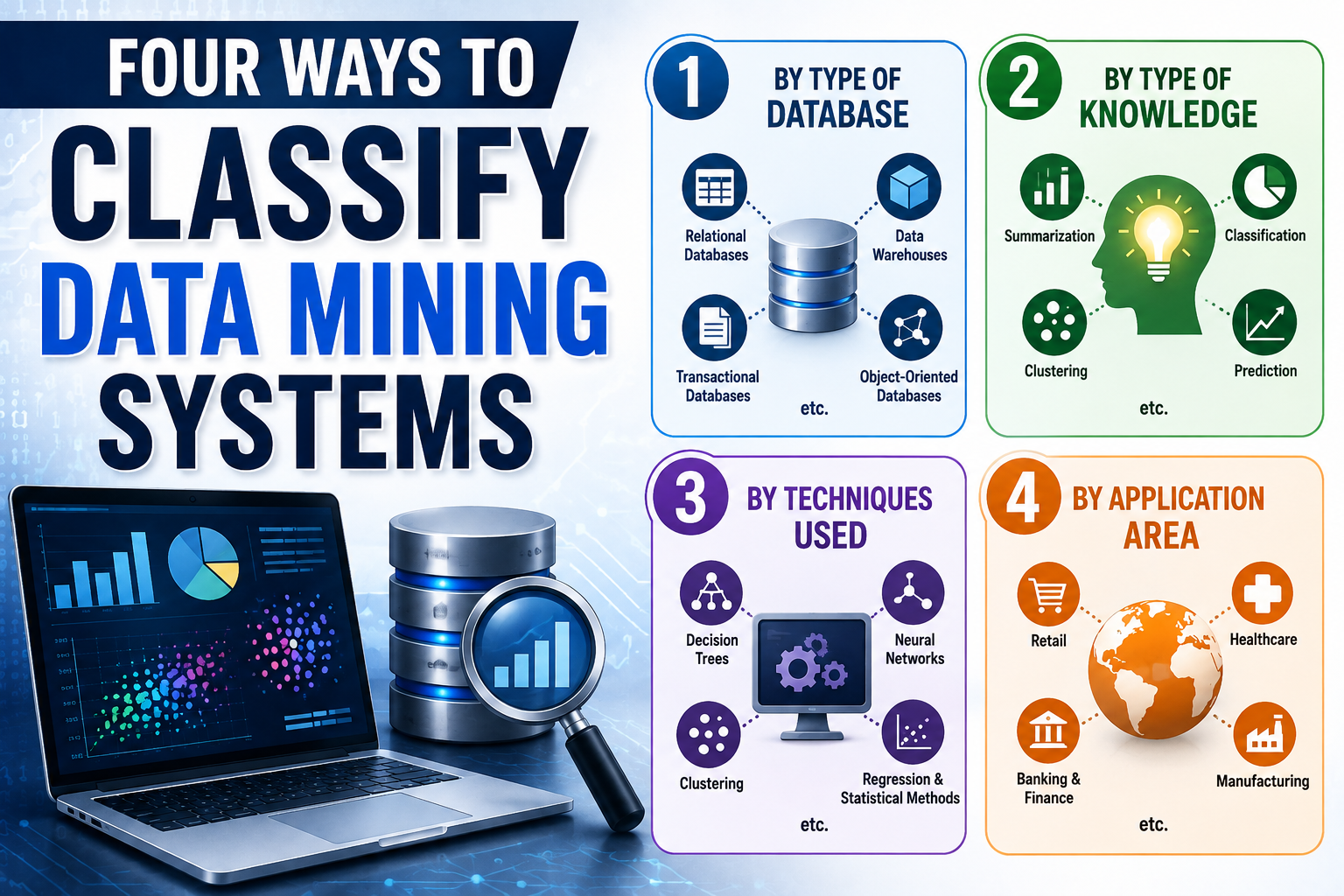
Data mining can be performed on data stored in several different kinds of systems.
1. Relational Databases
A relational database stores data as tables made up of rows and columns. Each table holds structured data that can be easily searched, joined, and reported on. Common examples include MySQL, PostgreSQL, and Oracle Database. Their structured, well-defined schema makes them one of the most common sources for data mining.
2. Data Warehouses
A data warehouse is a system that consolidates data from multiple sources across an organization — for example, combining records from marketing, finance, and sales — into a single system built for analysis and reporting rather than day-to-day transactions. This separation matters: a live transactional system optimized for fast reads/writes is usually a poor fit for the complex, large-scale queries that data mining requires, which is exactly the gap a data warehouse is designed to fill.
3. Data Repositories
A data repository is a central location where large amounts of data — databases, files, documents, and both structured and unstructured data — are stored and managed. Organizations use repositories to keep information organized and accessible for later analysis.
4. Object-Relational Databases
An object-relational database (ORDBMS) extends a standard relational database with object-oriented concepts, letting the schema itself support ideas like user-defined types, classes, objects, and inheritance. PostgreSQL is a well-known example of an object-relational database engine.
This is a distinct concept from **Object-Relational Mapping (ORM)** — a technique used in application code (in languages like Java, C++, or C#) to translate between objects in a program and rows in an ordinary relational database. ORDBMS is a property of the database engine itself; ORM is a layer in application code that talks to any relational database. It's worth keeping these two ideas separate, since they're easy to conflate.
5. Transactional Databases
A transactional database manages database transactions and ensures data integrity, typically by guaranteeing ACID properties — Atomicity, Consistency, Isolation, and Durability. In practice, this means the database can complete a transaction fully or roll it back entirely if something fails, so data is never left in a half-updated state. Most modern Database Management Systems (DBMS) support transactional features.
Common Data Mining Techniques
The "Data Mining" step of the KDD process can apply several distinct techniques, depending on what question you're trying to answer:
- Classification — assigns records to predefined categories based on labeled historical examples (for instance, marking an email as spam or not spam).
- Regression — predicts a continuous numeric value rather than a category (for instance, estimating a customer's likely spend next month).
- Clustering — groups similar records together *without* predefined labels, based purely on similarity in their attributes. Unlike classification, nobody tells the algorithm what the groups should be in advance; it discovers natural groupings on its own. A common example is segmenting customers into groups with similar purchasing habits, so each segment can be targeted with a different marketing approach.
- Association Rule Mining — finds relationships between items that frequently occur together, such as "customers who buy bread also tend to buy butter." This is the technique behind Market Basket Analysis, covered later in this lesson.
- Anomaly (Outlier) Detection — identifies records that deviate significantly from the norm, which is central to use cases like fraud detection and network intrusion detection.
These techniques aren't mutually exclusive — a single project might use clustering to segment customers and then classification to predict which segment a new customer belongs to.
Data Mining Tools
Data mining tools help analyze large datasets and surface hidden patterns without requiring every analyst to write algorithms from scratch. Some widely used data mining tools include:
- SAS Data Mining
- Orange Data Mining
- Rattle
- DataMelt
- RapidMiner
These tools typically provide visual, low-code interfaces for data analysis, visualization, and predictive analytics. Alongside them, many practitioners build data mining pipelines directly in code, using Python libraries such as pandas for data preparation and scikit-learn for classification, clustering, and other modeling techniques — an approach that offers more flexibility at the cost of a steeper learning curve.
Applications of Data Mining
Data mining is used across a wide range of industries. Some of the most significant applications include:
Data Mining in Healthcare
Healthcare organizations use data mining to predict diseases, improve patient care, detect healthcare fraud, and reduce costs — typically using a combination of machine learning, data visualization, and statistical analysis on patient and treatment records.
Market Basket Analysis
Market Basket Analysis studies customer purchasing behavior using association rule mining. For example, if a customer buys bread, the analysis might reveal they're also likely to buy butter. Retailers use these relationships to improve store layout, design better promotions, and increase sales.
Data Mining in Education
Educational Data Mining (EDM) analyzes student data to help institutions predict student performance, improve teaching methods, and provide more personalized learning experiences.
Data Mining in Manufacturing
Manufacturers use data mining to improve production processes, predict product demand, reduce manufacturing costs, and improve product design based on quality and usage data.
Data Mining in Customer Relationship Management (CRM)
CRM systems use data mining to understand customer behavior, which businesses then use to improve customer satisfaction, build loyalty, and develop targeted marketing strategies.
Data Mining in Fraud Detection
Fraud detection systems rely heavily on anomaly detection to flag suspicious activity, including credit card fraud, insurance fraud, and unusual online transaction patterns.
Data Mining in Banking
Banks generate enormous volumes of transaction data every day. Data mining helps them detect fraud, analyze customer spending patterns, improve customer service, and identify their most profitable customer segments.
Advantages of Data Mining
- Helps organizations extract useful insights from raw data
- Improves business decision-making
- Identifies hidden patterns that manual analysis would miss
- Predicts future trends and customer behavior
- Supports automation in data analysis
- Saves time and reduces operational costs
- Can be integrated with both new and existing systems
Challenges and Limitations of Data Mining
Despite its benefits, data mining faces several real limitations that any project needs to plan around.
Data Quality
Real-world data is often incomplete, inaccurate, or noisy — for example, incorrect phone numbers or missing customer information. Since data mining results are only as reliable as the underlying data, poor data quality directly undermines the value of any analysis.
Data Integration and Distribution
Data is often scattered across different systems, departments, and formats, and combining it into a single, consistent dataset can be difficult and time-consuming — this is precisely the problem data warehouses and the "Data Integration" step of KDD are designed to solve.
Complex Data Types
Modern datasets increasingly include images, videos, audio files, and time-series data, all of which require more specialized preprocessing and tooling than simple tabular data.
Performance and Algorithm Efficiency
The performance of a data mining project depends heavily on the efficiency of the algorithms and techniques chosen. Poorly suited algorithms can lead to slow processing or inaccurate results, particularly as dataset size grows.
Privacy, Ethics, and Security
Because data mining frequently involves personal information, organizations must ensure that data is collected, stored, and analyzed securely and in line with privacy regulations and ethical expectations.
Skill and Tool-Selection Barriers
Some data mining tools demand significant technical expertise, and choosing the right tool or technique for a given problem is often not obvious — a wrong choice can lead to misleading conclusions.
Communicating Results
Even a technically sound analysis is only useful if its results are presented clearly. Good data visualization is essential for turning statistical output into insights that non-technical decision-makers can actually act on.
Related Concepts
This lesson covers the foundations of data mining as a field. Two areas worth exploring next are the individual techniques introduced above — particularly clustering algorithms like k-means, and classification algorithms like decision trees — and the data preprocessing steps (cleaning, transformation, normalization) that determine how well any of those techniques perform in practice.